Following up on my generic research and audience research, these
are my current ideas for what I will feature in my music video and on my
website.
I still want my music video to focus on narrative, but I think
I will also include a performance aspect throughout the video. This was
something that my focus group liked the idea of, and it would also allow me to
get more close ups of the artist, reflecting Andrew Goodwin’s theory. The narrative
of my video will focus on a teenage boy struggling to come to terms with his
sexuality. The lyrics of the song I’ve chosen (‘Boys will be Bugs’ by Cavetown)
address the issue of toxic masculinity and it’s effect on teenage boys, and my
video will feature a gay main character who gives in to the pressures of toxic
masculinity, but eventually ends up being proud and expressing his identity. Since
the song I’ve chosen is in first person/from the perspective of a character (eg.
the lyrics ‘I’m a dumb teen boy’), the main character of my video (the artist)
will be lip-syncing the majority of the lyrics. I want my video to have a clear
aesthetic and colour palette, so I will have to bear this in mind when choosing
specific locations. At the beginning of my video, I would like to feature the
titles (‘Boys will be Bugs by *name of fictional artist*’) as a hand-drawn
animation as this is something that would show of my skills in other areas, and
would also interest the audience from the beginning of the video.
For my website, I will feature all the regular codes and
conventions of an artist’s website, including the artists logo in the top left
hand corner of the website (in the same hand drawn style as the titles in the
music video – digital convergence), a navigation bar with tabs such as ‘About’,
‘Music’, ‘Tour’, and ‘Store’, and the music video on the homepage. The homepage
will also feature photographs of the artist, and a short audio-visual clip – a
few of my ideas for this are a behind the scenes montage, an interview with the
artist, or a tutorial on how to make a ‘bug friend’ (these bug friends will be
featured as a prop in the video, so showing fans how to make their own would be
a nice idea). The website should have clear house style, using similar colours
and graphics to those featured in the music video, and should be easy to
navigate.
Monday, 8 June 2020

GENERIC RESEARCH: Summation
In my research, I have identified many codes and conventions of music videos, including:
·
A range of shot types
·
Many different locations
·
Intertextual references
·
A distinctive colour palette and aesthetic
·
A focus on narrative with performance aspects
·
Close ups of the artist/band (Andrew Goodwin’s music
video theory)
·
Features the artist as the star of the video (Richard
Dyer’s star theory)
·
The use of stereotypes, which are then later undermined
(this is more common in protest videos)
·
Makes a statement (again, this is more common in
protest videos)
·
Makes references to social/cultural/historical
context
·
Visuals that illustrate the lyrics (Andrew
Goodwin’s music video theory)
I have also identified the following codes and conventions in my research into artist’s websites:
·
A clear house style
·
The use of similar fonts throughout the website
(often similar to the font on the artists most recent album cover)
·
A distinctive colour palette (often reflecting
the colour palette/style of the artists recent music videos/album cover – showing
digital convergence)
·
The artists logo (usually in the top left corner)
acting as a home button
·
A navigation bar, usually featuring pages such
as ‘About’, ‘Tour’, ‘Music’, ‘Video’, and ‘Store’
·
A simple layout making the website easy to
navigate
·
Images of the star
·
The artists most recent music video(s)
·
Links to stream/download the artists most recent
album/single
·
A page dedicated to all the artists music, featuring
song lyrics and links to stream/download
·
A merchandise store
·
A page showing the artists upcoming
concerts/tour, including links to purchase tickets
·
Easter eggs
·
The option to sign up for email updates
·
Links to social media
I will use these codes and
conventions in my music video and website, such as:
·
Featuring the artist as the main focus of my
video, and using close up shots of the artist (relating to Andrew Goodwin’s
theory).
·
My music video will focus on narrative, and should
include a few shots of the artist performing throughout the video.
·
I will use intertextual references that my
target demographic should understand (but even if they don’t understand these
references the video will still make sense).
·
My video will feature several different
locations, including a garden, a science classroom, school halls, a bedroom,
and a few others (depending on what I have access to).
·
A lot of the visuals in my music video will
illustrate the lyrics (relating to Andrew Goodwin’s theory).
·
The website will have a clear house style that
reflects the music video, using a similar colour palette and similar fonts to those
used in the video.
·
The website will feature the music video on the
homepage (digital convergence).
·
The homepage will also feature a navigation bar,
featuring links to pages such as ‘About’, ‘Tour’, ‘Music’, ‘Video’, and ‘Store’
(making the website easy to navigate).
·
I will feature images of the artist on the
website, as well as a short behind the scenes video from the making of my music
video.
·
I will also create social media accounts for my
artist, which will be featured on the homepage of the website, encouraging fans
to interact with the artist.
Sunday, 17 May 2020
GENERIC RESEARCH: Websites Research
The
Regrettes website analysis


Cavetown website analysis


· When you first enter the website, a pop up
appears promoting the band’s latest album (sense of commercial imperative). The pop up allows you to click on ‘Listen Now’,
which takes you to a separate site that then asks you to choose a music service
(including Spotify, Amazon Music, iTunes Store etc.) where you can then
stream/download the music. There’s also an option that takes you to the music
video for ‘I Dare You’, one of the band’s latest releases.
· Another pop up appears when you scroll down to
the bottom of the website, offering you the opportunity to ‘Get on the list!’,
where you can input your email address to get on The Regrettes mailing list and
receive ‘exclusive information’ about their tour, video premiers and special
announcements. This mailing list offers fans the ability to be apart of a
community and makes them feel like they’re getting exclusive interactions with
the artist.
· The home page of the website has quite a
conventional layout, with the band’s logo (that acts as a home button when you
click it) in the top left-hand corner, and a navigation bar in the top right,
making the site easy to navigate.
· There is also a main image of the band that is
at the top of the website across all pages (establishes the band’s star
personas – links to Richard Dyer’s theory).
· As you scroll down the website, one of the first
things you see is an image of the band’s latest album, and two hyperlinks that
take you to a page where you can stream the music (again promoting the album
and encouraging people to stream/download).
· The band’s latest album cover features a bold,
80s style sans-serif font, and a primary colour scheme which is reflected by
the house style of the website (bold, sans serif fonts, colour scheme
consisting mainly of black, white, and primary colours) – this reflects the
band’s brand image, and is also an example of digital convergence.
· Below this, there is an option to subscribe to
the bands mailing list. Unusually, the band’s website doesn’t feature any links
to social media (other than YouTube), so this is the only way fans can
‘interact’ with the band directly from the website. However, linking social
media is the most obvious way to create digital convergence and would make it
easier for fans to interact with the band, so I do intend to link my artists
social media accounts to my website.
· This part of the homepage features videos from
The Regrettes YouTube channel (another example of digital convergence),
including recent music videos and home-made infomercials promoting their album.
These short videos could be seen as Easter Eggs, as most people would probably
just watch the music videos, and not take notice of the shorter promotional
videos unless they were fans of the band.
· If you click on the ‘Video’ text from the
navigation menu, it scrolls you down to this part of the homepage, rather than
opening a separate page.
· At the bottom of the homepage there is a list
showing some of the bands upcoming gigs, with hyperlinks to a ticket agency
where fans can purchase tickets.
· If you click on the ‘About’ text in the
navigation menu, it takes you to this page that tells you about the band, and
explains the meaning of their latest album. This is something I could feature
in my website, perhaps explaining the meaning of the latest video rather than
the album – this could even be done in video format with an interview from the
artist.
· This is the page that opens when you click on
the ‘Music’ option in the navigation menu. This page shows all the band’s
recent music, with hyperlinks to stream/purchase the all the songs/albums.
· As well as options
to buy/stream the music, fans can also view the lyrics to all the songs. The
play button next to the song titles also allows them to listen to the song
whilst reading through the lyrics. This encourages fans to listen to the songs
but also take a closer look at the lyrics.

· When you click on the ‘Store’ option in the
navigation bar, it takes you to a separate merchandise website where fans can
purchase the bands latest album on Vinyl and CD.
Cavetown website analysis
· This is the homepage for Cavetown’s website. The
website doesn’t have a very conventional layout, with Cavetown’s logo (that
also acts as a home button) at the top in the centre, and the navigation bar
not visible until you click on the circle in the top left corner. When you click
on this circle icon, the navigation bar shows options for ‘Tour’, ‘Store’, ‘Photos’
and ‘Music’. Personally, I prefer the navigation bar to be visible at all times
(like on The Regrettes website), as this makes the website easier to navigate.
· The first thing you see on the homepage is the artists
most recent music video (an example of digital convergence), promoting the
single and Cavetown’s upcoming album, and encouraging fans to engage with the
video. When you pause the video, an option for ‘more videos’ pops up, and four other
music videos from Cavetown’s YouTube channel can be seen.
· Below the video are three hyperlinks that take
you to different streaming websites where fans can pre-order the artist’s
upcoming album.
· The house style of the website is a mainly navy-blue
colour scheme, with white text in a sans-serif font. This colour scheme
reflects Cavetown’s latest album cover, which features mainly navy blue and
white (among other colours), creating a clear brand identity. The navy-blue
background of the website even features a repetitive print of a sleeping cat,
again reflecting the artists most recent album cover, which features a similar sleeping
cat. The majority of the text on the website does not include capital letters,
most likely for aesthetic reasons, but perhaps also because a lot of teenagers (who
the artist is most popular with) also type in this way.
· There is also an Easter Egg above the Cavetown
logo, which I will explain in more detail in a minute.
· Below the music video is the artists merchandise,
which is unusual, as most artists/bands have separate websites (linked in their
own websites) where their merchandise is sold. I like the idea of featuring
merchandise on the homepage of a website, as it means fans will definitely notice
it, and probably be more likely to purchase it than if it was on a separate website
that wasn’t as easy to find.
· A few of the clothing items are even modelled by
the artist (for example the hoodie in the top left of this screenshot), which would
probably make fans more likely to purchase merchandise, as it would make them
feel like they’re part of a community with the artist.
· At the bottom of the homepage, there are links to
all the artists social media, which is something very important in the digital
age, especially if your target audience is teenagers and young adults. I definitely
want to have links to my artists social media on my website as this is something
very important to my target audience, as it allows fans to interact with their
favourite artists/bands, and is also a good way to incorporate digital
convergence.
· This is the page that opens when you click on ‘Tour’
in the navigation bar, showing all the artists upcoming concerts, with
hyperlinks to ticket agencies where fans can purchase tickets. This page also
features an Easter Egg – if you click on the text that says ‘going to a show in
the us this fall? get involved!’, a separate page opens that looks like this:
· This page tells fans about a project the artist
has set up, where fans who come to their shows can donate items for animals and
people in need. I really like this idea, and if I set up a list of tour dates
on my website, I might do something similar.


· This is the page that opens when you click on the
‘Photos’ option in the navigation bar. These photos help establish the artists
star persona (Richard Dyer).
· The photos featured on this page are all from
concerts, encouraging fans to go to upcoming gigs by showing happy fans in the
audience watching the artist perform.

· This is the page that opens when you click on
the ‘Music’ option in the navigation bar. This page allows fans to listen to short
clips from all of Cavetown’s songs, and also gives them the option to stream the
full songs and albums on Spotify. It’s unusual that this page only give fans
the option to listen to the song on Spotify, as most artists websites give you
the option to stream/download from various different services.


· As mentioned previously, there is an Easter Egg
above the Cavetown logo on the homepage – if you click on the text above the
logo that reads ‘which cavetown artwork are you?’, it takes you to this separate
website. This interactive feature allows fans to take a short quiz to determine
which Cavetown painting they are, based off of things like eye colour, hair
colour and favourite animal. This is a fun Easter Egg for avid fans who know
that Cavetown is also a painter, and has painted a lot of his own album covers.

· This is the results page you see after taking
the quiz, where fans can then share the painting they got on Facebook or
Twitter – encouraging social media interaction. I really like this feature, and
I think it’d be nice to include an Easter Egg like this on my website (perhaps
a quiz like this one, or one that lets fans get to know the artist a bit better).
Conan Gray website analysis



Conan Gray website analysis

· This is the homepage for Conan Gray’s website.
The website has a conventional layout, with the artists logo (that also acts as
a home button) in the top left-hand corner, and a navigation bar in the top
right. The navigation bar has 4 options, ‘Tour’, ‘Music’, ‘Video’, and ‘Store’ –
‘Store’ is the only option that takes you to a separate website, ‘Tour’ takes
you to a different page of the website, and the other two just scroll you down
to the relevant section of the homepage.
· The first thing you see on the homepage is the
album cover of the artists latest album, and a hyperlink that takes you to a
website where you can choose which platform you want to use to download/stream
the album – as soon as fans enter the website they are encouraged to stream the
artists latest release. As well as the links to the latest album, there are also
3 other singles that can be streamed/downloaded if you swipe across your screen.
· The house style of the website is quite simple, consisting
of a black and white colour scheme, and a black italic sans-serif font. This colour
scheme is clearly reflected in the latest album cover, which is mostly black,
white, and grey. It gives the website a clean, minimalistic look, and creates a
clear brand identity for the artist (this is also an example of digital convergence).
The font used for the ‘Conan Gray’ logo is quite different from the other fonts
used on the website, but is similar to the one used on the album cover for the ‘Maniac’
single, so it still ties in with the overall look of the website.
· In my previous research, I looked in more detail
at a music video by Conan Gray, which has a very different aesthetic to this
current website, but this is because the video I looked at was from 2018, and the
style of his videos has changed a lot since then.

· Below the links to stream Conan Gray’s latest
album, there are two of his recent music videos, another example of digital
convergence. This also encourages fans to interact with the music video and acts
as a way of promoting the singles and album.
· Like all the other videos featured on artists
websites I’ve seen so far, this music video is from YouTube, confirming my research
that suggested YouTube is the most popular platform for music videos.

· Below the music videos is information about the
artists upcoming tour, which can also be seen in more detail by clicking on ‘Tour’
in the navigation bar. There is a personal message from the artist (establishing
his star persona) about the tour being postponed, followed by an image of the tour
poster (reflecting his brand identity).

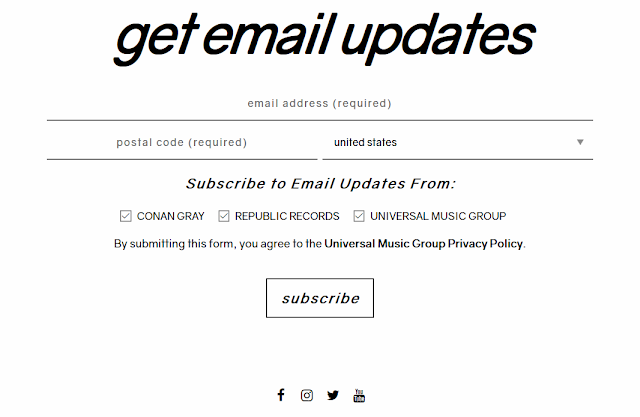
· At the bottom of the homepage, there is the option
for fans to subscribe for email updates. This allows fans to receive more
information about their favourite artist, and gives them a sense of community. I
like this idea, and I intend on making it a feature on my website.
· Below this, there are icons linking the artists
social media, another example of digital convergence. This encourages fans to
interact with the artist, and allows them to be a part of a community where
they are able to interact with other fans, and share things such as fan art or
fan made videos (Henry Jenkins fandom theory).

· This is the page that opens when you click on ‘Store’
in the navigation bar. This store is separate from the artists website, and features
a range of merchandise, including the album on vinyl and CD, and lots of
different clothing items. I would like to feature a few items of merchandise
for my artist on my website if possible.
· This page also gives you the option to sign up
to a newsletter, similar to the one at the bottom of the homepage on Conan Gray’s
website.
·
Tuesday, 12 May 2020
AUDIENCE RESEARCH: Summation
After asking questions to my focus group, and looking at the
consumption habits of my target demographic, I have made a few decisions that I
will keep in mind when moving forward. One thing I noticed after looking at the
answers to my focus group questions was that my target demographic seems to
prefer music videos that show both a narrative and an aspect of performance.
Initially, I had wanted to make a video that strictly focused on narrative, but
after seeing that the majority of my focus group liked a mix of both (but
leaning towards narrative), I will think about adding a small aspect of
performance to my music video (I have a few ideas for this). I also saw that
YouTube is the most popular platform for watching music videos, so I intend on
uploading my video to YouTube. My focus group and audience behaviour research
have also showed me that Spotify is the most popular music streaming service
used my target demographic, so I’ll put a link to the song on Spotify on the
homepage of my website. One answer to my focus group questions reflected the
idea of interaction with social media, which I know is something quite
important to my target demographic, so I intend on making an Instagram account
for my artist, and I’ll try to get a link on my website that takes you to the
account. Since the majority of my focus group said that they only really watch
music videos by their favourite artists, social media will also take a vital
role in promotion. I will need to create some social media content that stands
out and encourages my target audience to watch and engage with my music video.
AUDIENCE RESEARCH: Audience Behaviour
To take a closer look at the consumption habits of my target
audience, I looked at three different articles that reflect the way that music videos
are consumed nowadays.
https://www.refinery29.com/en-us/2017/08/169943/music-videos-history-popular-2017
This article asks the question ‘do teens still watch music videos?’ Since older teenagers are a part of my target demographic, I thought it would be interesting to see if they still take an interest in music videos. When teenagers were asked if they still watch music videos, one person answered that she might, ‘if I like both the artist and song’ (this is similar to some answers I received when asking my focus group questions). Another teenager mentioned that ‘sometimes a friend will be like 'watch this' if it's an artist they're super into, but they probably wouldn't post about it on social media.’ The article also states opposing stats from Vevo – ‘61% of teens say that they are watching more online video than they were last year (2017), and 73% say music videos are the best type of content for showing an artist's creative vision’ – suggesting that more teenagers take an interest in music videos than it may seem. The article suggests that ‘teens are engaging with music videos all the time — they just don't realize it.’ This is due to engagement – ‘watching a music video’ doesn’t mean what it did in the past. ‘There’s a next level engagement, what people are sharing, or commenting on, or talking about,’ Patel explains. ‘And then you have an even deeper level of engagement which is, people are...creating things out of that video, for example, memes.’ This article reflects on the idea that interaction with music videos has changed over time, and the idea that interacting with a video is often more than just watching it – and could instead be commenting, sending the video to friends, visiting an artists social media/website, buying merchandise, and other things along those lines.
https://nerdsmagazine.com/watch-music-videos/
This article shows the different websites that audiences can use to watch music videos. Although this article is quite old, it lists YouTube as one the most popular sites for watching music videos, which is still relevant today, as YouTube still seems to be the most popular platform that people in my target demographic tend to use when watching music videos. The article also lists Vevo and Vimeo as platforms that can be used to watch music videos, but after looking at the Vevo website, I noticed that the links to Vevo videos on the website take you to YouTube. Music videos on YouTube also get a lot more views than music videos on Vimeo, and my target audience is a lot more likely to interact with a YouTube video (as shown by the answers to my focus group questions).
https://blog.hubspot.com/marketing/online-music-listening-preferences
This article looks at the different ways that people consume music nowadays in the streaming era. The article shows the results of a survey that looked at the ways that 2,500 different people listen to music online, and shows that a small percentage (9% of those surveyed) chose ‘I primarily watch music videos online through something like YouTube’ when asked what is the primary way that they consume music. This shows that for some people, watching a music video will sometimes be the first time they hear a song, meaning a music video has to be a good visual representation of the song and its lyrics, as it will sometimes be the first impression that a person gets of an artist. The article also shows that over 50% of people use a music streaming service like Spotify. This article is a few years old, so this number is even higher now (Spotify currently has around 285 million monthly active users), and Spotify is very popular with my target demographic (as shown by the answers to my focus group questions). This suggests that when designing my website for my music video, it would be a good idea to have a link to the song on Spotify so that my target audience can stream the song.
https://www.refinery29.com/en-us/2017/08/169943/music-videos-history-popular-2017
This article asks the question ‘do teens still watch music videos?’ Since older teenagers are a part of my target demographic, I thought it would be interesting to see if they still take an interest in music videos. When teenagers were asked if they still watch music videos, one person answered that she might, ‘if I like both the artist and song’ (this is similar to some answers I received when asking my focus group questions). Another teenager mentioned that ‘sometimes a friend will be like 'watch this' if it's an artist they're super into, but they probably wouldn't post about it on social media.’ The article also states opposing stats from Vevo – ‘61% of teens say that they are watching more online video than they were last year (2017), and 73% say music videos are the best type of content for showing an artist's creative vision’ – suggesting that more teenagers take an interest in music videos than it may seem. The article suggests that ‘teens are engaging with music videos all the time — they just don't realize it.’ This is due to engagement – ‘watching a music video’ doesn’t mean what it did in the past. ‘There’s a next level engagement, what people are sharing, or commenting on, or talking about,’ Patel explains. ‘And then you have an even deeper level of engagement which is, people are...creating things out of that video, for example, memes.’ This article reflects on the idea that interaction with music videos has changed over time, and the idea that interacting with a video is often more than just watching it – and could instead be commenting, sending the video to friends, visiting an artists social media/website, buying merchandise, and other things along those lines.
https://nerdsmagazine.com/watch-music-videos/
This article shows the different websites that audiences can use to watch music videos. Although this article is quite old, it lists YouTube as one the most popular sites for watching music videos, which is still relevant today, as YouTube still seems to be the most popular platform that people in my target demographic tend to use when watching music videos. The article also lists Vevo and Vimeo as platforms that can be used to watch music videos, but after looking at the Vevo website, I noticed that the links to Vevo videos on the website take you to YouTube. Music videos on YouTube also get a lot more views than music videos on Vimeo, and my target audience is a lot more likely to interact with a YouTube video (as shown by the answers to my focus group questions).
https://blog.hubspot.com/marketing/online-music-listening-preferences
This article looks at the different ways that people consume music nowadays in the streaming era. The article shows the results of a survey that looked at the ways that 2,500 different people listen to music online, and shows that a small percentage (9% of those surveyed) chose ‘I primarily watch music videos online through something like YouTube’ when asked what is the primary way that they consume music. This shows that for some people, watching a music video will sometimes be the first time they hear a song, meaning a music video has to be a good visual representation of the song and its lyrics, as it will sometimes be the first impression that a person gets of an artist. The article also shows that over 50% of people use a music streaming service like Spotify. This article is a few years old, so this number is even higher now (Spotify currently has around 285 million monthly active users), and Spotify is very popular with my target demographic (as shown by the answers to my focus group questions). This suggests that when designing my website for my music video, it would be a good idea to have a link to the song on Spotify so that my target audience can stream the song.
Sunday, 10 May 2020
AUDIENCE RESEARCH: Focus Group Questions
Below are the questions I asked my focus group
1. How often do you watch music videos? (eg. often, rarely, only when my favourite artists upload one)
2. What platform do you use to watch music videos?
3. Would you interact with a music video after watching it if you enjoyed it? (eg. by leaving a comment, visiting the bands social media or website)
4. Do you ever download/purchase music after watching a good music video?
5. Do you watch music videos for the video or just for the song?
6. Do you prefer narrative music videos (music videos that tell a story) or performance music videos (that show the band playing the song) or do you prefer a mix of both (a video that shows a narrative as well as the band performing)?
7. What is your favourite music video and why?
8. What streaming service do you use to listen to music? (eg. Spotify, Apple Music)
Here are their answers:
Tito
1. Only when my favourite artists upload one.
2. YouTube
3. Yes, I’ll probably comment or visit their social media.
4. Yes, always.
5. For the video mostly but sometimes for the song.
6. A mix but leaning towards narrative music videos as I think they’re more interesting.
7. Do It All The Time by IDKHBTFM due to its performance aspects and also all the visuals and storytelling within it. I also liked One Last Time by Ariana Grande because of the story telling in it and for the nostalgia.
8. Spotify
Alex
1. Usually only when my favourite artists upload one, but sometimes I might watch one in my Youtube recommended if it looks interesting.
2. YouTube
3. Maybe if it was one of my favourite artists, but not usually.
4. Yes, if it’s a good song.
5. For the video.
6. A mix of both but I prefer narrative videos.
7. Life Itself by Glass Animals because I like how it's a part of a bigger story with the other music videos from the album. I also like the visuals and I think it's cool that the meaning is quite subjective.
8. Spotify
Amber
1. Only when my favourite artists upload one.
2. YouTube
3. I’d probably just like the video
4. Yes
5. For the video
6. A mix of both.
7. Thriller by Michael Jackson because I like the story and the visual style.
8. Spotify
Leon
1. Rarely
2. YouTube
3. No
4. I usually only watch videos by bands I know, so I’ll probably have the music downloaded already.
5. I usually watch for the song but I like to see its video representation. If the graphics are good or I like the style of the video then I might watch more by the same artists to see the videos.
6. Narrative
7. Paranoid Android by Radiohead, because of the cool graphics, animation and colour. It’s unusual and I like that.
8. Spotify
Tuesday, 5 May 2020
Subscribe to:
Posts (Atom)
-
 Here is the basic layout for my second page (the About page). I obviously need to add text to the boxes, and I will probably tweak a few thi...


